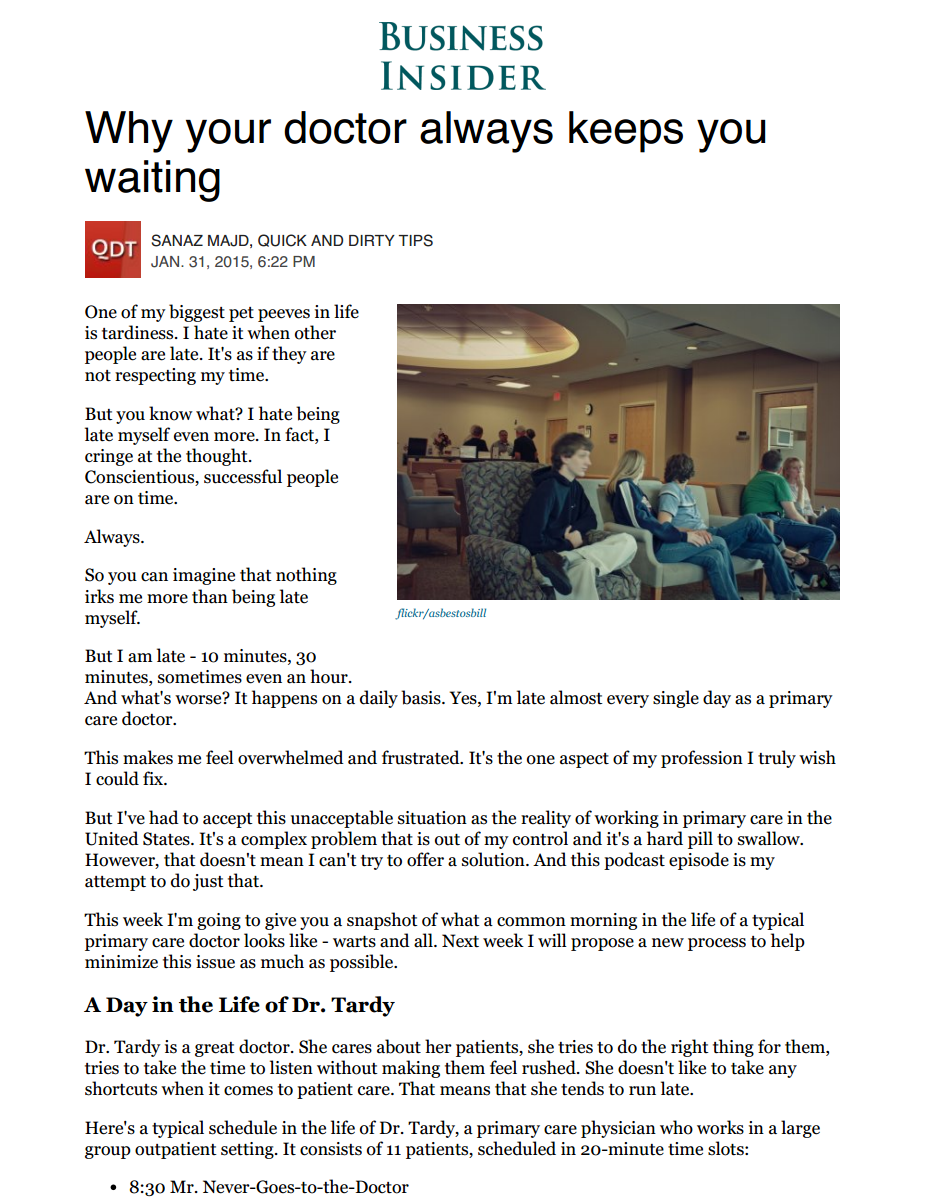
A friend shared this article, “Why your doctor always keeps you waiting”. Take a look.
It perfectly sums up the struggle of a day in clinic for a primary care physician (family doctor). I can identify strongly with the author, Dr Sanaz Majd. She’s thorough, she’s dedicated, she cares about her patients, she doesn’t mind that much missing a lunch, and she cannot live with doing anything less than her best.
Trouble is, this kind of care is not sustainable. It is a recipe for burnout.
Is the answer to see fewer patients? Yes, that might help but then many Canadians would be without a doctor, we would not earn the money required to pay overhead, malpractice insurance, to attend conferences, or to live well. We have worked hard and a lot of us (those who aren’t yet burnt out) take a lot of our work (figuratively and literally) home with us.
Are we greedy? Maybe. But if someone got into medicine to make money, they are in the wrong field! Most clinicians are book-smart enough to succeed at business or investing or something else that is less personally demanding, but we enjoy medicine because it is a challenge not just intellectually, but emotionally. It is an opportunity to do something to help others while at the same time feeling stimulated and productive.
I get paid well, and I appreciate that is recognition for the intensity and length of my education, for the responsibility I assume, and for the fact that is is not “just a job” but a life and I cannot turn off ‘being a physician,’ ever.
In addition to lots of journal article reading to keep up to date, I also spend about 20 hrs a week working (without pay) on my project, Less is More in Medicine. This involves reading related articles, spreading the word on twitter, attending conferences, preparing lectures, networking, teleconferences, etc. all on my own time. I do it because I am passionate about it and feel I have a duty to make the health care system better. If I could get paid for it, that would be great! In fact, that’s a dream.
If I was paid to do the advocacy work that I feel is so important, then I could have more time to practice the “wellness” that I preach to patients. Constantly I am bombarded with messages from friends and family to “slow down.” My very patient partner has advised me that I need to view this advocacy work as ‘work,’ and take time for myself, but I haven’t done very well at listening. He suggests I take one week off each month, which technically I do (I keep it free from clinical work) but (he’d tell you) I fill it with meetings and writing and preparing for conferences. Plus I work some of the nights and weekends during the rest of the month, so I wind up doing as much clinical work as anyone else, and I enjoy this also. Whether paid or not, I will continue my advocacy work, because I cannot let go.
There are a lot of mixed messages. On the one hand, I hear I should make sure I am well: As a physician I advise exercise, healthy eating, meditation/self-reflection, and community involvement. I have seen burn-out and suicide and hospitalization of my colleagues thanks to the pressures of this profession. Numerous groups, like The Physician Health Program of BC have talks and booths at conferences, reminding us to take care of ourselves before we take care of others. Parents and partners worry.