
James McCormack (@medmyths, The Best Science Medicine Podcast) sent me a great article: "Patient-Accessible Tool for Shared Decision Making in Cardiovascular Primary Prevention."
The UK group looked at the problem of patients discontinuing medication and focussed in particular on statins for primary prevention of cardiovascular events. A lot of research assumes that the 'burden' of taking a pill is a negligible factor in medication adherence, but these researchers thought otherwise. They surveyed 360 people to see how they might balance their potential cardiac risk with the 'disutility' of a preventative, once a day medication as intervention. Paraphrasing, they wanted to know:
how much longer would a person need to live (thanks to a medication) in order to make it worth the hassle of taking the medication
The article is worth sharing because it introduced a few new ideas to me:
- "disutility" : a word the researchers use to capture the idea of inconvenience or burden of care
- there is some good evidence that educating people more and more about their risk will not change their adherence to medication
- talking about reasons they would not want to take the medication may be more important
- as every person has a different tolerance of disutility, individualized discussions (shared decision-making) still remains a good strategy
- for people who fall in the middle ground when balancing utility and disutility, factors like gender, smoking, blood pressure, and cholesterol factor into the decision whereas they do not for those with high or low disutility
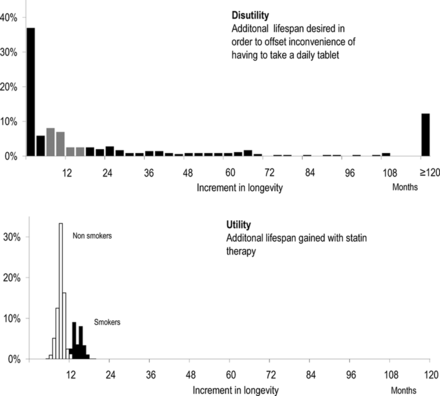
Figure 4.
Disutility vs utility. Frequency distribution of disutility, longevity benefit that subjects expressed a desire to make tablet therapy worthwhile (top), and the frequency distribution of utility, actual expected gain in lifespan from statin therapy in the English population (bottom). The difference between the 2 values is the net benefit of tablet therapy. Because utility has a very much narrower spectrum than disutility, for those with a high disutility, regardless of utility, statins are a net harm; for those with low disutility, regardless of utility statins are a net benefit. It is only for those in the middle gray zone (top) that sex, smoking status, blood pressure, and cholesterol are the deciding factors.
Read the full article here, in Circulation.
If you are very interested in the idea of 'disutility,' you may enjoy Dr Victor Montori (@vmontori)'s work on "Minimally Disruptive Medicine."