Choosing surgery wisely: the importance of evidence-based practice
Meti, N., Rousseau, M., Grad, R. Medicine, McGill University, Montreal, Canada.
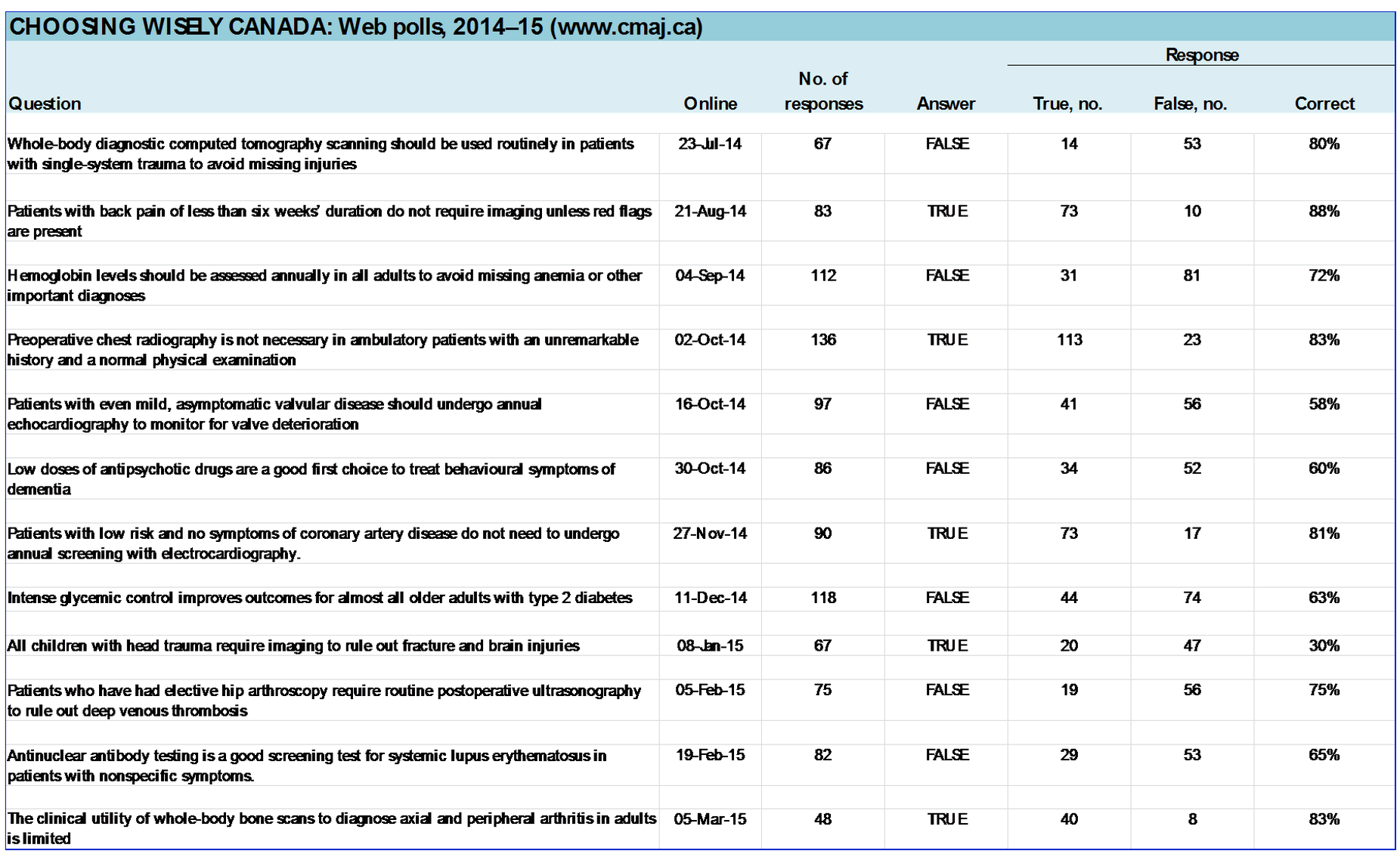
An emerging trend among physician organizations is to attempt to control or reduce the rate of unnecessary medical tests and treatments. Until recently, the principle manner to release updated recommendations for practice was through meetings where experts discussed which tests or treatments needed to be questioned.
We developed a novel means of analyzing nascent research articles for their applicability towards improving the “Choosing Wisely” topic selection process [1]. This method is based on analyzing the ratings of daily POEMs, collected from physician members of the CMA. POEMs are tailored synopses of primary research or systematic reviews, selected by searching over 100 journals. POEMs are delivered to over 20,000 members of the Canadian Medical Association (CMA) by email on weekdays.
At the 2015 ‘Preventing Overdiagnosis’ conference, one of us (RG) will report on the top POEMs of 2014, as rated by CMA members with respect to their potential to help them to ‘avoid an unnecessary diagnostic test or treatment’ [1]. Of the topics addressed by these top 20 POEMs of 2014, only 2 were discussed in the Choosing Wisely master list of recommendations. Of the remaining 18 topics, three were related to surgical interventions; we highlight their important findings.
In a study published in The Bone and Joint Journal, Kukkonen et al. used the Constant Shoulder Score to show that among patients with symptomatic non-traumatic supraspinatus tears, physiotherapy alone is as effective as physiotherapy combined with acromioplasty after 1-year follow up [2].
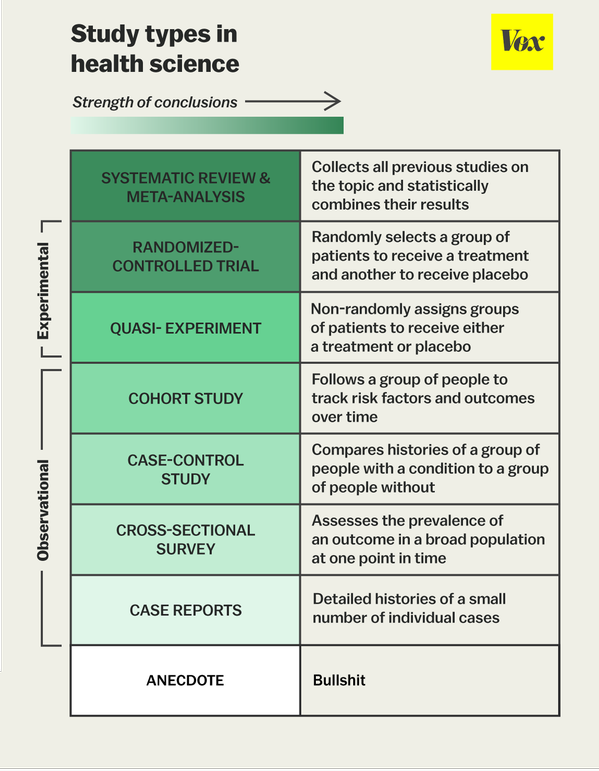
In a study published in the New England Journal of Medicine, Sihvoven et al. investigated whether arthroscopic surgery would improve outcomes for select patients with a degenerative tear of the medial meniscus. The researchers conducted a multicenter, randomized, double-blind, sham-controlled trial involving patients without knee osteoarthritis, but with symptoms of a degenerative medial meniscus tear. Surgery was found to be ineffective for non-traumatic partial medial meniscus tears [3].
A study published in JAMA by Primrose et al. [4] questioned the routine practice of intensive follow-up after surgery for colorectal cancer, as there existed no evidence to support this common practice. In a randomized controlled trial, 1,202 participants were assigned to 4 groups: CEA only, CT only, CEA+CT, or minimum follow-up. Their results demonstrated that among patients who had undergone curative surgery for primary colorectal cancer: 1) intensive imaging or CEA screening each provided an increased rate of surgical treatment of recurrence with curative intent, compared with minimal follow-up; 2) there was no advantage in combining CEA and CT; and 3) there was no statistically significant survival advantage to any strategy.
One concern about the development of top five lists in Choosing Wisely is the potential for individual specialties to choose the low hanging fruit. For example, the American Academy of Orthopaedic Surgeons included no major surgical procedures in their top 5 list, despite evidence of wide variation in elective knee replacement and arthroscopy rates [5]. This observation is not meant to be a criticism of orthopedic surgeons per se, as many surgeons are strong advocates for their patients (see http://www.thepatientfirst.org). [Less is More readers will remember one of the founders, Dr James Rickert, from What Can Patients Do in the Face of Physician Conflict of Interest]
Our point is to drive home the underlying philosophy of the “Choosing Wisely” campaign: ‘routine’ testing or treatment without evidence-based support can be found insidiously entrenched in all disciplines.